
When Digital Transformation Is Well Executed—but Business Value Remains Unclear
- December 19, 2025
- Posted by: Arvant
- Categories: Digital Transformation, ERP Systems, ROI
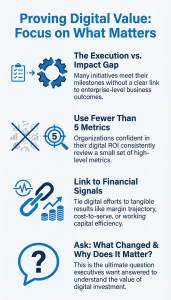 Digital transformation initiatives today are often executed better than ever before. Organizations successfully implement ERP platforms, cloud solutions, analytics tools, and automation technologies. Projects are delivered on schedule, adoption is monitored, and governance structures are in place.
Yet, in many executive and boardroom discussions, a familiar question persists:
What has actually changed for the business?
This gap between execution and impact is increasingly common—and it is rarely driven by technology limitations.
The Digital Transformation ROI Challenge
Across industries, digital transformation programs deliver what they promise from a technical perspective. Systems go live, processes are digitized, and data becomes more accessible. However, when leadership teams assess outcomes, the connection between these initiatives and measurable business performance is not always clear.
The challenge is not whether technology was implemented, but whether it materially altered how the organization operates, competes, or creates value. In many cases, success is measured through activity indicators—deployment milestones, adoption rates, or system usage—rather than enterprise outcomes.
A CEO Perspective: Aligning Digital Transformation to Strategy
From a CEO perspective, high-impact digital transformation is defined less by tools and more by strategic effect.
Where transformation delivers sustained value, there is typically evidence of:
-
Clear alignment with strategic priorities
-
Improved decision-making speed and quality
-
Tangible shifts in customer experience or market responsiveness
-
Greater organizational agility and scalability
When these shifts are visible, digital initiatives reinforce competitive advantage. When they are not, technology risks being viewed as peripheral to the broader business agenda.
A CFO Perspective: Confidence Built on Financial Outcomes
For CFOs, confidence in digital investment increases when outcomes are visible in a limited set of financial signals.
Organizations that demonstrate stronger confidence in digital ROI often point to improvements such as:
-
Margin expansion or protection
-
Reduced cost-to-serve
-
Improved working capital efficiency
-
Lower operational or compliance risk
When these signals are absent, value remains difficult to substantiate—even when delivery has been successful. This often leads to increased scrutiny of future digital investments.
A CIO Perspective: From Delivery to Value Realization
For CIOs and technology leaders, delivery and adoption are essential foundations—but they are rarely sufficient on their own.
In organizations where digital transformation creates long-term value, CIOs focus on:
-
Translating platforms into repeatable business capabilities
-
Linking technology initiatives to enterprise KPIs
-
Sustaining value realization beyond initial implementation
In these environments, IT is positioned as a strategic enabler of business performance rather than a delivery or support function.
An Alignment Insight Across Leadership
A recurring pattern across transformation programs is subtle misalignment:
-
IT measures delivery and system performance
-
Finance measures cost and budget adherence
-
Business leaders focus on outcomes and results
Digital transformation accelerates when these perspectives converge around a shared definition of value—reviewed consistently at executive and board level.
Notably, organizations that report higher confidence in digital ROI tend to focus on a small number of enterprise metrics, rather than a broad and fragmented set of indicators.
The Boardroom Lens on Digital Transformation
At board level, discussions typically move quickly beyond implementation detail. The focus often narrows to a simple question:
What changed, and why does it matter to the business?
Clear answers to this question build confidence in the transformation agenda. Ambiguity, even in the presence of advanced technology, can undermine it.
Closing Reflection
Digital transformation is increasingly well executed. The differentiator today lies in how clearly value is defined, measured, and sustained over time.
If the impact of your digital transformation initiatives had to be described using a single metric, which one would best capture the change delivered?
About Arvant Business Solutions
Arvant Business Solutions helps organizations translate digital transformation initiatives into measurable business outcomes. We work with leadership teams across asset-intensive and operationally complex industries to bridge strategy, technology, and execution—ensuring digital investments deliver sustained value.