
Why AI-Driven ERP and CRM Are the Future of Business Transformation
- October 1, 2025
- Posted by: Arvant
- Category: ERP Systems
Introduction
In today’s fast-moving digital economy, businesses can no longer rely on traditional ERP and CRM systems alone to stay competitive. While these platforms have long been the backbone of enterprise operations and customer engagement, the real game-changer now is Artificial Intelligence (AI). By embedding AI into ERP and CRM, organizations can unlock predictive insights, streamline decision-making, and create personalized experiences at scale. This shift is not just a trend—it’s the future of business transformation.
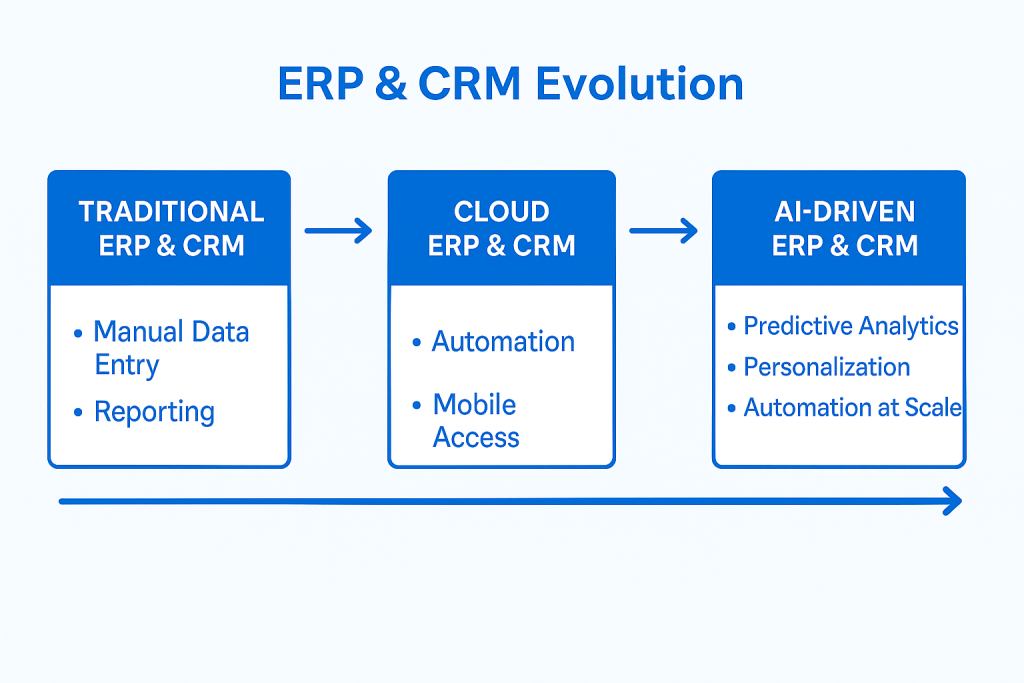
The Evolution of ERP and CRM
Traditionally, ERP (Enterprise Resource Planning) systems centralized core business functions—finance, supply chain, HR—while CRM (Customer Relationship Management) solutions helped companies track and manage customer interactions. Both were critical, but they were often reactive in nature: recording what has happened, not predicting what will happen.
With the infusion of AI, these systems are evolving from static record-keeping tools into intelligent business partners. AI enables ERP and CRM platforms to anticipate needs, automate complex processes, and deliver recommendations in real-time.
Key Benefits of AI in ERP and CRM
1. Predictive Decision-Making
AI algorithms analyze historical and real-time data to forecast demand, optimize inventory, and predict customer behavior. Instead of reacting to problems, businesses can prevent them before they occur.
2. Smarter Customer Engagement
AI-powered CRMs use natural language processing (NLP) and machine learning to personalize communications, recommend next-best actions, and even predict churn—helping sales and service teams build stronger relationships.
3. Process Automation
Routine tasks like invoice approvals, purchase requisitions, and support ticket assignments can be fully automated with AI, reducing manual effort and allowing employees to focus on higher-value work.
4. Enhanced Data Accuracy
AI improves data quality by automatically detecting errors, duplication, or anomalies. In ERP systems, this ensures more reliable financial and operational reporting.
5. Faster Implementations & Upgrades
Modern AI-driven platforms streamline data migration, integration, and user adoption by automating repetitive implementation tasks and providing intelligent system configuration.
Real-World Use Cases
-
Manufacturing: Predictive maintenance powered by AI reduces downtime by anticipating equipment failures before they happen.
-
Retail: AI-driven CRM suggests personalized promotions to customers based on past buying behavior, boosting conversion rates.
-
Finance: Intelligent ERP systems detect fraudulent transactions in real-time and automate compliance checks.
-
Services: AI chatbots integrated with CRM improve first-response rates and provide instant support, enhancing customer satisfaction.
The Strategic Advantage
The true value of AI in ERP and CRM lies in its ability to align technology with business strategy. Instead of just running operations, organizations can use AI insights to shape long-term growth, identify new revenue streams, and respond quickly to market changes. Early adopters gain a measurable competitive edge by operating more efficiently while delivering superior customer experiences.
Conclusion
The integration of AI into ERP and CRM is no longer optional—it is essential for future-ready enterprises. Businesses that embrace this transformation will not only streamline operations but also unlock new opportunities for growth and innovation.
At Arvant Business Solutions, we help organizations design, implement, and optimize ERP and CRM platforms enhanced with AI capabilities. Whether you’re modernizing legacy systems or building new digital solutions, our expertise ensures a smooth transition and measurable outcomes.
Ready to future-proof your business? Contact us today for a strategy session and discover how AI-driven ERP and CRM can transform your operations.